This is one of the most common sources of confusion for people researching families from the former Russian partition.
When a Polish surname was written using the Cyrillic alphabet, it subsequently had to be converted back into the Latin alphabet.
There was not always one universally consistent way of doing this.
As a result, a surname could acquire different Latin spellings depending on who translated or transliterated it and when.
For example, a surname containing Polish sounds that do not exist in exactly the same form in Russian or English could be represented in several ways.
This does not automatically indicate a different family.
It may simply reflect the language and alphabet used by the person creating the record.
Another major source of variation is emigration.
When Polish immigrants arrived in countries such as the United States, Canada, the United Kingdom, or Australia, their names were often recorded by officials who did not speak Polish.
A clerk might write down what they heard.
The immigrant might also choose to simplify the spelling of their surname.
Over time, the family itself could adopt a new spelling.
For example:
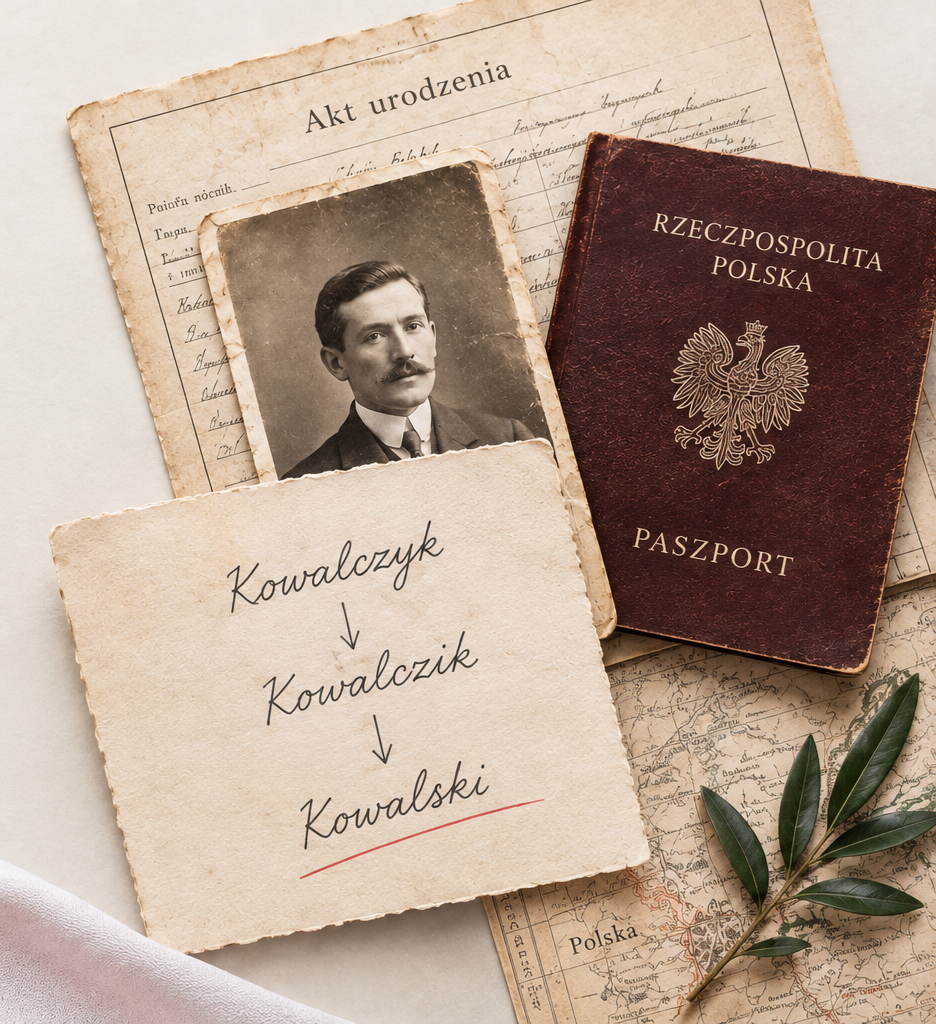
Kowalczyk → Kowalczik → Kowalcik
Or:
Wojciechowski → Wojciechowsky → Wojciechovsky
These changes could happen gradually, sometimes within a single generation.
The important point is that a changed spelling does not necessarily mean a changed identity.
Historical records were created by people.
And people make mistakes.
A surname might be:
- misheard;
- misspelled;
- abbreviated;
- written with a different ending;
- copied incorrectly from another document;
- affected by poor handwriting;
- recorded differently by different officials.
This is particularly common when dealing with handwritten historical records.
Imagine an American census taker trying to understand a Polish surname spoken with a strong accent.
The resulting spelling may have very little resemblance to the original Polish spelling.
That does not make the document useless.
Quite the opposite: the document may still be extremely valuable if the other details match.
Polish is a highly inflected language, and surnames can change their form depending on how they are used in a sentence.
This can occasionally create additional confusion when comparing historical records.
For example, a surname may appear in a nominative form in one context and a different grammatical form in another.
There are also historical differences in how women's surnames were recorded.
In older Polish records, particularly those written in traditional Polish, Latin, or Russian, a woman's surname may not always appear in exactly the same form that you would expect from a modern record.
This is one reason why searching only for an exact surname spelling can cause researchers to miss relevant records.
Sometimes the change went further than a simple spelling variation.
After emigrating, some families deliberately adapted their surnames to make them easier to pronounce or spell in their new country.
This could involve:
- removing Polish diacritics;
- simplifying difficult consonant combinations;
- replacing Polish letters with approximate equivalents;
- shortening the surname;
- changing the spelling to match local pronunciation;
- or, in some cases, adopting an entirely different form.
For descendants researching their family today, this can make the original Polish surname surprisingly difficult to identify.
You may have heard that certain Polish surnames can be recognized by their endings.
Common examples include:
-ski / -ska
-wicz
-czak
-iak / -ek / -ik
These endings can sometimes provide useful clues when researching a family.
However, a surname ending alone cannot prove that someone was Polish.
Surname formation was influenced by many languages, regions, and historical circumstances. Similar endings can also occur outside Poland.
Think of a surname as a clue, not a conclusion.
The real work is connecting the person to the correct place, time, parents, spouse, and other family members.
This is where genealogical research becomes much more interesting.
Instead of asking:
“Is the surname exactly the same?”
ask:
“Do the other facts indicate that this is the same person?”
Look for multiple matching details, such as:
Date of birth
A difference of a few years may be explainable, particularly in later immigration records. But a completely different age should be investigated carefully.
Place of birth
A village, parish, county, or region can be much more useful than the surname itself.
Keep in mind that the place name may have changed depending on the historical period and language of the record.
Parents
Parents' names are often among the strongest clues for connecting records.
Spouse and children
If the same unusual combination of spouse and children's names appears across several documents, this can be strong evidence that you are following the same family.
Occupation
An occupation can sometimes help distinguish between two people with similar names.
Immigration information
Passenger lists, naturalization records, censuses, and other immigration documents can provide valuable information about an ancestor's origin and identity.
Witnesses and other relatives
Godparents, witnesses to marriages, neighbors, and other relatives can sometimes reveal connections that are invisible when looking at the surname alone.
urname variations are not simply a genealogical curiosity.
They can become particularly important when researching Polish ancestry across multiple generations.
A family might have:
One surname in a Polish birth record → another spelling in a marriage record → a third version after immigration.
If you search only for the modern spelling, you may never find the original Polish record.
This is especially important when researching ancestors whose records were created in different languages or under different political administrations.
A difference in spelling is not automatically a problem, but it needs to be evaluated in context.
The best approach is to build the chain of evidence.
Start with the documents you already have and record every variation of the name you encounter.
Then compare:
- names;
- dates;
- places;
- parents;
- spouses;
- children;
- occupations;
- immigration details;
- and other identifying information.
The goal is to establish whether the documents refer to one person appearing under different forms of their name, or to genuinely different people.
That distinction is crucial.
If you are researching your Polish ancestry because you are interested in Polish citizenship by descent, surname variations do not necessarily prevent you from proving your family connection.
However, citizenship cases require more than simply demonstrating that a surname “looks Polish.”
The relevant question is whether you can establish the identity and continuity of the individuals in your family line and document the transmission of Polish citizenship under the laws applicable at the relevant time.
That means historical records need to be assessed as a whole.
A spelling difference between your ancestor's Polish birth record and a later immigration document may be perfectly explainable.
On the other hand, if the documents contain significant differences in dates, places, parents, or other identifying information, further research may be necessary before the records can safely be connected.
If your Polish ancestor's surname appears differently in different records, don't immediately assume that you've hit a dead end.
Poland's complex history, multilingual records, migration, transliteration, and ordinary clerical mistakes have left many families with surnames that changed along the way.
Sometimes the spelling changed — but the person didn't.
And when researching Polish ancestry, that distinction can be incredibly important.
If you are trying to determine whether your family history may support a Polish citizenship claim, our team can help you assess the available records and identify what additional documentation may be needed.
Get Polish Citizenship — Your Gateway to Europe. 🇵🇱🇪🇺